The adoption of unified data layers has accelerated in recent years, enabling machines on the shop floor to seamlessly exchange information. This increased connectivity generates vast amounts of data, unlocking a wide range of AI-driven applications.
Industrial AI agents are now emerging across the manufacturing value chain. Unlike traditional automation, these agents do not require pre-programmed instructions prior to deployment, making them particularly well-suited for dynamic manufacturing environments. Today, deployment remains in its early stages and truly end-to-end industrial Agentic AI systems have yet to materialize. Agents are increasingly being embedded as subsystems within existing software platforms. Their rapid implementation is most evident in high-frequency, feedback-rich scenarios, which is driving early adoption in manufacturing. Production scheduling on the shop floor is a prime example, which we will examine in more detail below.
Our research focuses 4 main categories – production & process optimization, intelligent production, intelligent safety & quality control, OT Security – as highlighted in the image below.
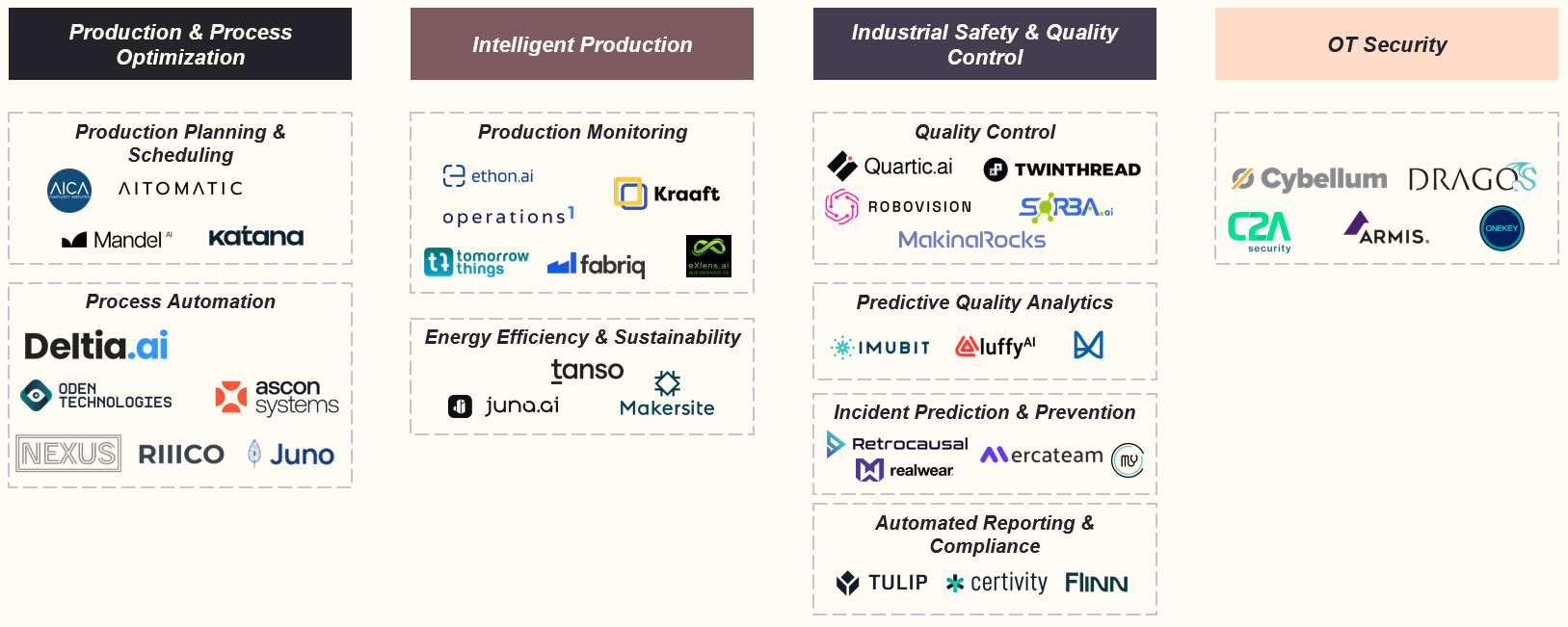
1. Production & Process Optimization
This remains one of the most active domains of Manufacturing AI at the application layer, with AI agents now transitioning from research to real industrial deployments. The industrial sector faces constant pressure to improve productivity, reduce costs, maximize asset utilization, and ensure high-quality outputs. The status quo within the enterprise largely relies on incumbent legacy systems, manual processes, and siloed data—creating fertile ground for AI applications.
AI-driven production and process optimization addresses these needs by:
- Demand and inventory planning to reduce forecasting errors, optimize production schedules, and minimize stockouts and overproduction.
- Automating decision-making on the shop floor.
- Optimizing resource allocation (bill of materials, energy, labour).
- Improving product quality via continuous monitoring and feedback loops.
⇒ We can broadly categorize AI agents in this space into two main groups. Below, we explore what these agents do and highlight examples from both our pipeline and the broader market.
1.1. Production Planning & Scheduling
AI agents in this category ingest real-time enterprise data (ERP, procurement, logistics, sales) and autonomously generate demand forecasts, optimize inventory levels and trigger replenishment, adjust production schedules, re-prioritize jobs and allocate resources, simulate scenarios and flag risks/opportunities – often with minimal human intervention.
Example companies:
- Mandel.ai – builds autonomous agents acting as AI-powered supply chain planners. Mandel’s agents continuously analyze enterprise data to identify bottlenecks, optimize workflows, and generate proactive recommendations, reducing manual planning and increasing resilience.
- Katana MRP– manufacturing ERP focused on real-time visibility. Katana uses AI to synchronize sales, inventory, and production data, allowing manufacturers to make quick and informed production decisions, particularly in make-to-order and direct-to-consumer (D2C) setups.
- AITOMATIC – delivers purpose-built AI agents tailored for semi-conductors, maritime and energy to support decision making, for route optimization and managing grid performance.
1.2. Process Automation
On the shop floor, AI is increasingly central to process automation—executing repetitive tasks, monitoring production parameters in real-time, and autonomously intervening to maintain optimal throughput and product quality. No-code and low-code platforms further accelerate adoption by enabling shop floor operators and non-technical staff to deploy AI agents for automating quality inspections, compliance monitoring, predictive maintenance, and workflow orchestration, driving higher efficiency and flexibility across manufacturing operations.
Example companies:
- Ascon Systems – allows enterprises to model, adapt and execute processes and system logic based on digital twins to increase the flexibility and reliability of production through process orchestration and standardization.
- Juno Tech – builds agentic process bots that monitor manufacturing KPIs and autonomously adjust workflows to meet defined thresholds.
- Riiico – provides a 3D digital twin platform that helps industrial players simulate and optimize factory layouts and production flows.
- Oden Technologies: real-time analytics agents that monitor factory data, to better understand the current state on the plant floor and optimize decisions.
- Nexus – combines a cloud-native Process Engine with AI-native architecture. Nexus integrates with existing control systems to analyze data and deliver real-time recommendations, enabling continuous process improvement.
- Deltia AI – employs visual digitisation to convert manual production processes, encompassing tasks like assembly, packaging, and machinery adjustments, into actionable insights
- AICA – develops advanced robotics software that enables manufacturers to automate and optimize industrial and collaborative processes through real-time adaptive control and autonomous learning capabilities.
2. Intelligent Production
2.1. Production Monitoring
AI-native MES are beginning to emerge, currently focusing on specific use cases rather than providing comprehensive, end-to-end solutions for live manufacturing.
Traditionally, Manufacturing Execution Systems (MES) served as systems of record, with limited machine-to-machine communication. Today, next-generation MES platforms are leveraging AI in two key ways: optimizing productivity in real time and monitoring or predicting plant failures. Companies such as EthonAI, eXlens.ai, and TomorrowThings are deploying AI to pinpoint the root causes of issues, whether through machine-generated data or visual inspections using existing cameras. These companies are also beginning to implement AI agents capable of autonomously resolving problems, although this technology is still in its early stages. A notable leader in the field is unicorn Augury, which currently focuses on AI-driven machine health monitoring, highlighting the significant growth potential in this area.
Another crucial aspect of production monitoring is maximizing productivity through enhanced employee collaboration. Here, AI streamlines operations by delivering the right tools and information at the right moment in the production process. Companies like Operations1, Fabriq, and Kraaft provide real-time checklists, communication platforms, task management, and automated reporting to support live production activities.
2.2. Energy Efficiency & Sustainability
While digital twins are not new, most scaled software platforms have long embedded them into plant control systems to optimize throughput, reduce costs, and improve resource and energy efficiency. What’s changing now is scope: AI-powered digital twins are expanding beyond the shop floor to model the entire production plant. Seattle-based Phaidra is gaining traction in this space, backed by Index Ventures, with a focus on maximizing throughput by minimizing time and resource use—often expanding into energy optimization and sustainability over time. In Europe, the ecosystem is earlier-stage, with Germany’s Juna AI emerging as a notable pre-seed player backed by Kleiner Perkins.
Beyond operational gains, Europe is at the forefront of embedding sustainability into manufacturing, a critical shift given the sector’s significant share of global emissions. Connecting data across production and supply chains enables optimization of routes, bills of materials, and other key levers—reducing costs while ensuring compliance across Scopes 1–3. For example, Makersite delivers automated, sustainability-first PLM insights across manufacturing and supply chains, while Tanso provides granular carbon reporting tailored to industrial operations.
We believe the winners in this category will be next-generation PLM platforms where sustainability, resource efficiency, and energy optimization are core architecture—not add-ons—driving measurable ROI through smarter resource allocation.
3. Industrial Safety & Quality Control
Industrial quality control and safety are mission-critical across manufacturing, logistics, and other asset-intensive industries. Failures can lead to recalls, downtime, regulatory breaches, and—most critically—risks to human life. As production environments grow more complex and compliance demands increase, manual inspections and rule-based automation are no longer sufficient.
AI agents offer a scalable solution, enabling real-time monitoring, adaptive decision-making, and continuous optimization. By reducing defects, waste, and recall risk, they improve efficiency while allowing skilled workers to focus on higher-value tasks.
These systems typically combine machine learning, computer vision, and sensor data (image, acoustic, and process signals). Two core industrial layers—Human–Machine Interface (HMI) and Supervisory Control and Data Acquisition (SCADA)—are natural integration points:
- HMI: Operator interface for monitoring and controlling machinery.
- SCADA: Plant-level system aggregating and analyzing data from equipment and sensors.
Embedding AI into HMI and SCADA shifts operations from reactive monitoring to proactive quality and safety management—improving response times and resilience. However, integration with legacy systems remains a significant technical and organizational challenge, and adoption is still early.
We see several key applications for AI agents in this category:
3.1. (Predictive) Quality Analytics
AI agents leverage computer vision and sensor data to inspect products and components for defects, anomalies, or deviations from specifications in real time. This replaces or augments manual inspection, increasing consistency and speed while reducing human error.
Example companies:
- Robovision – a pioneer in AI-powered visual inspection, Robovision provides adaptable, no-code tools to train and deploy computer vision models on industrial lines.
- MakinaRocks– AI agents for anomaly detection and predictive quality analytics in manufacturing (e.g. developing AI-powered battery inspection system)
- Quartic.ai, Sorba.ai, TwinThread– agents for continuous process monitoring and early defect detection across industrial lines.
We also see several start-ups evolve from pure visual inspection to predictive quality analytics, i.e. analyze process data in order to predict when quality issues are likely to occur, enabling proactive adjustments to maintain standards and reduce scrap or rework.
Example companies:
- Imubit– deep learning agents optimize process variables in real time to keep operations within quality and safety limits.
- Luffy.ai, Manex AI– agents for predictive maintenance and quality analytics, minimizing unplanned downtime and ensuring consistent output.
3.2. Incident Prediction & Prevention
By analysing historical and real-time data, AI agents can predict high-risk situations and recommend or take preventive actions—such as slowing production, evacuating areas, or scheduling targeted training.
Example companies:
- Retrocausal: Agents for assembly line safety and quality, using video analytics to anticipate and prevent incidents.
- Mercateam: AI-driven skills management and safety training, ensuring the right people are assigned to hazardous tasks
- RealWear: augmented reality software for frontline workers to ensure prevention on the industrial field
- MyC: enables organizations to efficiently manage medical facilities and health services in any environment, offering electronic health record management, real-time analytics, and compliance with global standards
3.3. Automated Reporting & Compliance
These are AI agents that automatically generate and validate quality and safety documentation, ensuring regulatory compliance and providing auditable records for inspections or incident investigations.
Example companies:
- Tulip: No-code platform enabling deployment of AI agents for safety checks, incident logging, and skills tracking.
- Certivity: develops innovative software to seamlessly connect legal and regulatory requirements with engineering processes in the automotive industry
- Flinn.ai: AI-driven platform that enables MedTech companies to automate and optimize regulatory and quality processes
4. Operational Technology (OT) Security
Operational Technology (OT) security protects the hardware and software that monitor and control physical processes across manufacturing, energy, transportation, and utilities. This includes industrial control systems (ICS), SCADA, distributed control systems (DCS), and programmable logic controllers (PLCs). Unlike IT systems, OT environments prioritize uptime and safety, making them far less tolerant of downtime for patches or updates.
As cyber threats grow more sophisticated, OT security is critical to preventing severe operational, economic, safety, and environmental damage. AI is shifting the field from reactive defense to predictive protection—enabling faster threat detection, automated response, and proactive risk management. However, success depends on securing legacy infrastructure, managing AI-driven adversarial risks, and balancing automation with human oversight—especially as IT/OT convergence accelerates.
OT security applies at both the manufacturing and product levels:
- At the plant level, Germany-based ONEKEY focuses on automated cybersecurity and compliance for connected devices, detecting zero-day vulnerabilities, generating software bills of materials (SBOMs), and supporting compliance with the EU Cyber Resilience Act.
- At the product level, C2A Security and Cybellum provide AI-driven, context-aware DevSecOps platforms that automate cybersecurity and risk management for software-defined products—particularly in automotive and mobility – protecting vehicles across their lifecycle.
More mature U.S. players such as Dragos and Armis demonstrate clear scaling potential in the category. Overall, we believe OT security is at a clear inflection point, with AI accelerating the need for faster, predictive protection of critical infrastructure – from manufacturing plants to connected products.
5. Conclusion
Industrial AI is reaching an inflection point. With unified data layers, better sensorization, and increasingly capable foundation models, manufacturers are beginning to deploy autonomous agents that move beyond decision‑support into real decision‑making across production, quality, maintenance, and safety. Adoption is still early, but ROI is already evident in high‑frequency, data‑rich workflows such as scheduling, process optimization, and predictive quality.
The broader ecosystem is also taking shape. Digital twins, AI‑native MES, sustainability‑focused PLM, and OT security platforms are emerging as horizontal enablers that will underpin more integrated, end‑to‑end systems. However, the category remains fragmented: deployments are often point solutions, integration with legacy OT is slow, and data silos still limit full‑factory optimization. Hardware dependencies in areas like safety and robotics further constrain scaling.
Despite these challenges, momentum is accelerating. Strategic buyers and next‑generation software players are driving the market toward consolidation and platformization. At Forestay, we truly believe that the combination of clear ROI, large industrial TAM, and increasing enterprise appetite for autonomous decision‑making represents a compelling opportunity. In the near term, agentic AI will remain embedded within existing software; over time, we expect these capabilities to converge with physics‑based AI and robotics, enabling far more automated – eventually highly autonomous – industrial environments.
References and Resources:
- https://lovelytics.com/navigating-2025-with-ai-data-genai/
- Report_-The-AI-opportunity-in-manufacturing.pdf
- https://medium.com/@dawncapitalteam/part-i-introduction-to-industry-4-0-14e0211cccf0
- https://www.sciencedirect.com/science/article/pii/S000785062400115X
- https://automazione-plus.it/wp-content/uploads/sites/3/2025/04/Report_-The-AI-opportunity-in-manufacturing.pdf
- https://harlem.capital/wp-content/uploads/2024/05/HCP_AI-for-Manufacturing-Deck.pdf
- https://blog.lnsresearch.com/five-ways-industrial-ai-is-shaking-up-manufacturing-and-whos-doing-it
- https://www.ngpcap.com/insights/the-most-exciting-time-to-invest-in-industrial-tech-in-decades
- https://medium.com/@HitachiVentures/unlocking-value-through-industrial-ai-agents-navigating-the-path-to-autonomy-4f708375a9bb
- https://reprints2.forrester.com/#/assets/2/174/RES180867/report
- https://www.enterracorp.com/post/how-ai-iot-and-cybersecurity-are-transforming-critical-infrastructure-enterra-s-vision-for-the-fu